How to find IT tenders in the UK on Find a Tender
By Voin Srezoski. Published .
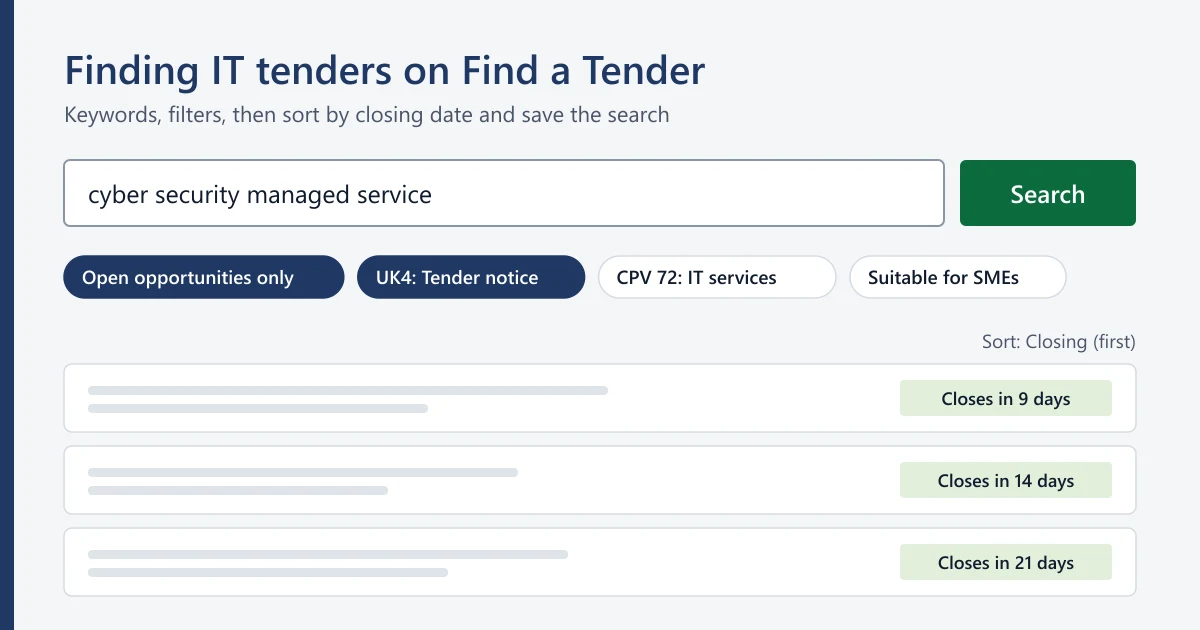
Find a Tender is the UK government's free portal for public contract notices. Set it up once and IT tenders reach you by email the day they are published, so you start with the full 30 days: search by keyword and CPV code, filter to open tender notices, sort by closing date and save the search.
What is Find a Tender?
Find a Tender is the UK government's free portal where public sector buyers publish what they plan to buy, what they are tendering and who won. Set it up properly and the right IT tenders reach your inbox on the day they are published, not the week before they close.
The size of the prize: £385 billion is spent through UK public procurement every year, on the government's own figure. On 14 November 2026 the Find a Tender search held 328,939 notices.
The problem is time. The typical IT tender gives you 30 days from publication to deadline, and one in four gives under 25. Find it on day 12 and you have lost more than a third of your time before you open a document. Find it on day one and you have all of it.
Find a Tender has been the central digital platform under the Procurement Act 2023 since 24 February 2025. The Cabinet Office says it is "free to use for everyone". The address is find-tender.service.gov.uk.
The 30 day figure is from our analysis of 266 Find a Tender notices for IT services published 14 November 2025 to 28 February 2026. Typical means the median. Contains public sector information licensed under the Open Government Licence v3.0.
Which contracts appear on Find a Tender?
More than most small firms think. For procurements started since 24 February 2025, Find a Tender carries above-threshold and below-threshold notices from UK contracting authorities, except below-threshold procurements in Scotland. That puts contracts from £12,000 upwards in one search, including the smaller ones a new bidder can win.
| Contract type | Threshold from 1 January 2026 (including VAT) |
|---|---|
| Goods and services, central government | £135,018 |
| Goods and services, other authorities (councils, NHS, housing, education) | £207,720 |
| Works | £5,193,000 |
| Light touch contracts | £663,540 |
These figures are from PPN 023 and apply until 31 December 2027. Some official pages, including the Find a Tender home page, still showed the previous figure of £139,688 on 14 November 2026. Use the table above.
Below those values, a buyer that advertises a contract must first publish a below-threshold tender notice if it is worth £12,000 or more for central government, or £30,000 or more for other authorities, including VAT. These are the contracts where the entry rules are lightest. Our guide to the Procurement Act 2023 for small IT suppliers explains why.
How do you search for IT tenders in the UK?
Open the notice search, tick "Open opportunities only", add your keywords or CPV codes, sort by closing date and save the search. From then on, new matching notices come to you by email, and you stop losing days to tenders you found late.
The filters, as labelled on the site:
- Keywords: searches "titles, descriptions, identifiers and organisation names".
- Procurement stage: Pipeline, Planning, Tender, Award, Contract, plus "Open opportunities only".
- Notice type: the individual notice codes, such as UK4 for a tender notice.
- Industry CPV code: a browser for the Common Procurement Vocabulary.
- Contract location, Value and Dates.
- Suitability: contracts marked as suitable for small and medium-sized enterprises (SME).
A routine that works for an IT firm:
- Save one search on CPV codes beginning 72 (IT services) and one on codes beginning 48 (software packages).
- Save a keyword search for each thing you sell: "managed service", "cyber security", "Microsoft 365", "software development", "cloud hosting".
- Sort by "Closing (first)" to see what is urgent.
- Select "Save search", name it and choose how often to be emailed. This needs a free account.
The summarised search groups all the notices for one procurement and shows its current status, so you can follow a contract from plan to award.
Which notice types should a small IT firm watch?
Watch five. Pipeline and market engagement notices tell you what is coming before your competitors start. Tender notices are the live opportunities. Award and contract notices tell you who won, for how much, and when the contract will come round again. Procurement Act notices are numbered UK1 to UK17.
| Notice | What it tells you | What you gain |
|---|---|---|
| UK1 Pipeline notice | What a buyer expects to procure | Months to prepare |
| UK2 Preliminary market engagement notice | The buyer is consulting suppliers | A say in the requirement |
| UK4 Tender notice | A live opportunity | The one to bid for |
| UK6 Contract award notice | Who the buyer intends to award to | Your competitors, named |
| UK7 Contract details notice | The signed contract's details | The date it comes up again |
The award and contract notices are free market research. A three-year contract awarded today tells you when that buyer will be back in the market and who you will be up against.
Do you need to register on Find a Tender?
Not to search. You must register as a supplier before you bid under the Procurement Act 2023, because buyers take your core details from the platform. Register now, while nothing is due, and a missing registration can never be the reason a bid goes in late.
Registration has three parts, according to the Cabinet Office guide:
- Create a GOV.UK One Login with your work email address.
- Complete your Find a Tender account details.
- Register your organisation as a supplier, using your Companies House number if you have one. The platform then shows your unique identifier.
Then enter your core supplier information: basic details, recent accounts, connected persons and exclusion grounds. When you bid, you share it with that buyer by a share code. Our guide to the PSQ shows where the code goes.
Where else are UK IT tenders published?
In four places: Contracts Finder for lower value contracts, the national portals for Scotland, Wales and Northern Ireland, buyers' own e-procurement portals, and frameworks such as G-Cloud. Cover all four and you see the whole market, not the slice one portal shows.
- Contracts Finder lists contracts "worth over £12,000 (including VAT)" with the government and its agencies. Search it as well as Find a Tender.
- Public Contracts Scotland, Sell2Wales, eTendersNI and eSourcing NI serve the devolved nations.
- Frameworks. A lot of IT buying never appears as an open tender. In a three-week sample of Contracts Finder notices we analysed, 193 of 257 IT services notices were call-offs under frameworks. The best known is G-Cloud, which the government expects to carry about £3 billion of cloud spend a year.
What should you do when you find a tender worth bidding for?
Move the same day. Download every document, note the deadline for questions and the deadline for bids, and check the pass or fail conditions before anything else. The sooner you know what the tender demands, the more of your 30 days goes on answers that score.
The tender notice must say "how tenders may be submitted and the date by when they must be submitted". From there the work is the same every time: read, list the requirements, decide, then write. Our guide on how to write a tender response covers each step.
Or hand over the first read. Paste the notice link into Bid Writing Pack and within one working day you have what can knock you out, what the buyer will score, each with its page number, and a bid or no-bid view. Packs are generated by AI and each quote is checked against the page it cites. Your first one is free, one per company: see the sample bid pack.
Questions
Is Find a Tender free to use?
Yes. The Cabinet Office states that Find a Tender is free to use for everyone. Searching and reading notices needs no account. A free account, created with GOV.UK One Login, lets you save searches, receive email alerts and register your organisation as a supplier so that you can bid.
What is the difference between Find a Tender and Contracts Finder?
Find a Tender is the central digital platform under the Procurement Act 2023 and carries notices for procurements started since 24 February 2025, above and below threshold. Contracts Finder is the older service for contracts worth over £12,000 including VAT with the government and its agencies. Search both so that lower value work does not pass you by.
What value of contract appears on Find a Tender?
For procurements under the Procurement Act 2023, above-threshold contracts and notifiable below-threshold contracts both appear. From 1 January 2026 the main thresholds are £135,018 for central government and £207,720 for other authorities, including VAT. Below-threshold notices start at £12,000 for central government and £30,000 for other authorities.
Do I submit my tender through Find a Tender?
Usually not. Find a Tender publishes the notice. The tender notice must state how tenders may be submitted and the deadline, and most buyers use their own e-procurement portal or, for small contracts, email. Follow the submission instructions exactly, because a bid sent the wrong way can be disregarded.
Which CPV codes cover IT tenders?
Public notices are classified with Common Procurement Vocabulary (CPV) codes. IT services sit under codes beginning 72 and software packages under codes beginning 48. Buyers do not always classify consistently, so add keyword searches such as cyber security, managed service, software development or cloud hosting to catch the rest.
Sources
- Find a Tender service (home page)
- Find a Tender notice search
- Public Procurement: Growing British industry, jobs and skills. Government response to consultation (CP 1541, March 2026)
- Central Digital Platform factsheet, Cabinet Office
- How to register your organisation and find your unique identifier: a guide for suppliers, Cabinet Office
- Buyers and suppliers: how to use the Central Digital Platform, Cabinet Office
- PPN 023: 2026 Threshold Amounts, Cabinet Office
- Guidance: Thresholds, Cabinet Office (updated 13 July 2026)
- Guidance: Below-Threshold Contracts, Cabinet Office (updated 13 July 2026)
- Contracts Finder, GOV.UK
- The Procurement Regulations 2024, regulation 18: tender notices, open procedure