What is a PSQ (Procurement Specific Questionnaire)?
By Voin Srezoski. Published .
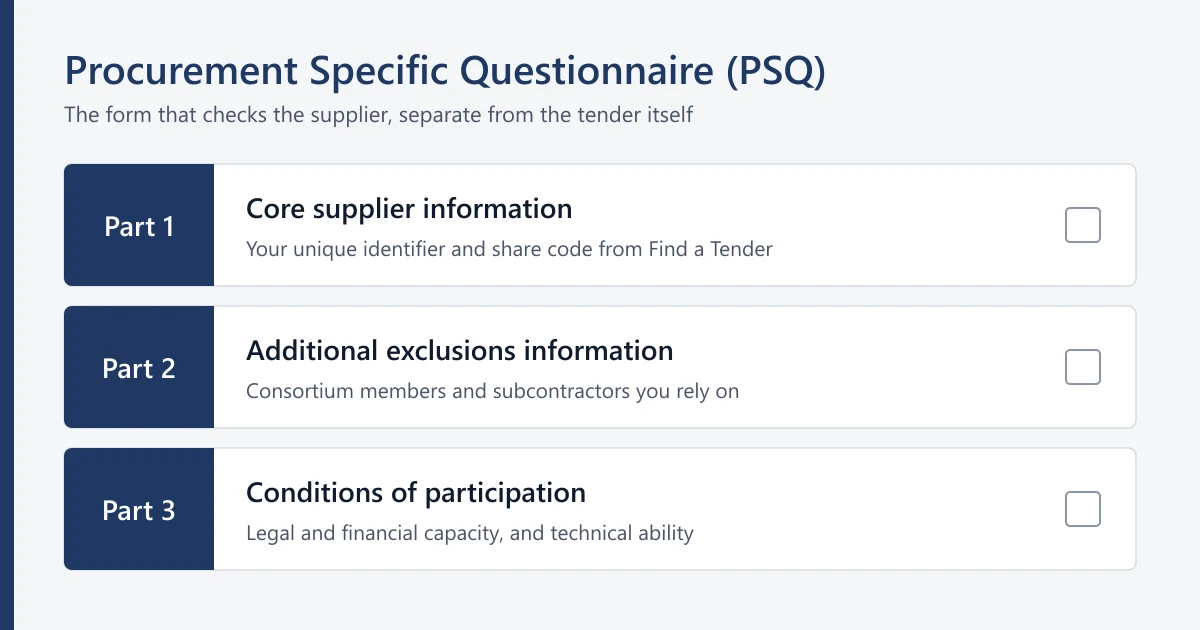
A PSQ, or Procurement Specific Questionnaire, is the form a UK public buyer uses to decide whether your tender gets scored at all. Pass it and your answers are read. Fail one condition and they are not. It has three parts: your registration details, exclusions information for firms you rely on, and the conditions of participation.
What is a PSQ in procurement?
A PSQ is a Procurement Specific Questionnaire: the form a UK public buyer uses to decide whether your tender gets scored at all. Your tender says how you would deliver the contract. The PSQ says who you are and whether you qualify. Fail it and nobody reads the answers you spent weeks on.
That is the law, not a buyer's habit. Under section 19 of the Procurement Act 2023, a buyer "must disregard any tender from a supplier that does not satisfy the conditions of participation". Must, not may.
The conditions are rarely few. In one live £140,000 IT tender we broke down, 62 of 86 requirements were mandatory, and the PSQ alone asked for three reference contracts, three kinds of insurance and confirmation that the supplier could deliver the whole scope. Read the PSQ first and you know early whether the tender is yours to win.
The Cabinet Office published the PSQ template in December 2024 and updated it to version 2.0 in February 2025. Its explainer calls the PSQ "separate from the formal tender submission". You will find it among the documents attached to a tender notice: see what an invitation to tender contains.
What is in the three parts of a PSQ?
Part 1 confirms your registration on the central digital platform. Part 2 covers the other firms you are relying on. Part 3 sets the conditions of participation for this contract. Part 3 is the one that changes from tender to tender, and the one that decides whether you should bid.
| Part | What it covers | What you do |
|---|---|---|
| Part 1: core supplier information | Your registration on the central digital platform | Give your unique identifier and share code |
| Part 2: additional exclusions information | Consortium members and key subcontractors you rely on, plus a list of all intended subcontractors | Share their details and exclusions information |
| Part 3: conditions of participation | Legal and financial capacity and technical ability for this contract | Answer and evidence each condition |
In version 2.0, Part 3 has standard questions and a second set that central government buyers add under procurement policy notes.
Buyers adapt the layout, because the Act does not fix a format. A PSQ published by the Legal Aid Agency in July 2025 uses Part A for the platform confirmation, Part B for the conditions and Part C for the declaration. Read the one in front of you, not the one you completed last time.
How is a PSQ different from the old selection questionnaire (SQ)?
It is less typing and more deciding. Under the old selection questionnaire you re-entered your company details in every bid. Under the PSQ, those details sit on the central digital platform and are shared by code, so your time goes on the conditions that are specific to this contract.
The explainer puts it this way: suppliers "should no longer have to re-enter this information for each public procurement but simply ensure it is up to date and subsequently shared".
You will still meet the older form. Procurements and frameworks that started before 24 February 2025 continue under the previous rules, and the standard selection questionnaire in PPN 03/24 was written for them. The older term "PQQ" survives in conversation too. Our Procurement Act 2023 guide explains the two regimes.
What do you need before you can complete a PSQ?
Four things: a supplier registration on the central digital platform (the Find a Tender service), complete core supplier information, a share code for this buyer, and the same from any partner you rely on. Have them ready before a tender lands and Part 1 is quick.
Core supplier information has four groups, according to the Cabinet Office factsheet:
- Basic information: name, address, Companies House number or equivalent, VAT number if you have one, and whether you are a small or medium-sized enterprise.
- Financial information: copies of recent accounts.
- Connected persons: people or organisations with influence or control over the business.
- Exclusions: whether any mandatory or discretionary exclusion grounds apply.
You are responsible for its accuracy, so check it each time you bid.
The trap is partners. Any firm you rely on to meet a condition is an "associated person". The explainer says their exclusions information must be shared with the buyer, and that you must give "an exhaustive list" of all intended subcontractors. Tell your partners on day one. A subcontractor who registers late can hold up your whole bid.
How is a PSQ assessed?
Mostly pass or fail. Some answers are for information only. Others are assessed against a pass mark or a threshold. Fail a condition of participation and the buyer must disregard your tender. Know which questions are which and you know exactly what stands between you and being scored.
The explainer's wording is that assessed information "might include a pass or fail mechanism, or a threshold which the supplier must meet". Where a buyer uses the PSQ to shortlist, it must set out the maximum number of suppliers and the selection criteria in the tender notice.
In a single-stage open procedure, guidance says the conditions may be assessed in parallel with the tenders. So you normally send the PSQ and the tender together, and a failed PSQ means the tender is not scored.
What can a buyer not ask for in a PSQ?
Less than you might expect. Section 22 of the Act says conditions of participation must be a proportionate way of checking your legal and financial capacity or technical ability, and it rules out four demands that can keep small firms out. Know them and you can challenge a condition before the deadline for questions.
A buyer may not:
- require audited annual accounts, except from suppliers that are legally required to have their accounts audited;
- require insurance relating to the contract "to be in place before the award of the contract";
- require suppliers "to have been awarded a contract by a particular contracting authority";
- require particular qualifications "without allowing for their equivalents".
So a PSQ can ask you to commit to holding £5 million of cover by the contract start date. It cannot make you buy the policy before you know you have won. And it cannot shut you out because you have never worked for that council.
What do IT tenders typically ask in Part 3?
Financial standing, insurance, past contracts, security certifications and policies. Two published PSQs show the range: one from a central government agency and one from a housing association buying a managed security service. Line your evidence up against lists like these now and the next PSQ is a filing job.
- The Legal Aid Agency PSQ asks for a financial viability assessment, confirmation of employer's liability insurance, a modern slavery statement where the supplier is large enough to need one, and a commitment to "Hold Cyber Essentials Certification and provide evidence of this by Contract Start Date".
- The PSQ in our sample bid pack, for the £140,000 managed detection and response contract, asks for three reference contracts from the last three years, employer's and public liability insurance of £10 million each, professional indemnity of £2 million, and confirmation that the supplier can deliver the whole scope.
A bid pack puts each PSQ requirement in a compliance matrix with its page number, so you can see on one page whether you pass. Packs are generated by AI, each quote is checked against the page it cites, and yours arrives within one working day. The first is free, one per company.
How do you avoid failing a PSQ?
Register first, read Part 3 before anything else in the pack, and answer every question with evidence somebody other than you could verify. The avoidable failures are simple ones: a missing share code, an unsigned declaration or a condition nobody checked until the last day.
- Register and complete your core supplier information before you need it.
- Read Part 3 and decide whether you pass. If you do not, stop, and keep the weeks the bid would have taken.
- Tell your partners early. Associated persons need their own registration.
- Answer the question asked. If it says "confirm", confirm. If it asks for three references, give three.
- Sign the declaration, and check the submission method and deadline.
Questions
What does PSQ stand for in procurement?
PSQ stands for Procurement Specific Questionnaire. It is the Cabinet Office template that public buyers use under the Procurement Act 2023 to collect information about a supplier for one particular procurement. Your general details are held on the central digital platform, and the PSQ covers what is specific to the contract.
Is a PSQ scored?
Mostly it is pass or fail. The Cabinet Office explainer says some PSQ information is for information only and other information is assessed, which might be by a pass or fail mechanism or a threshold. In some procedures a buyer can also use it to shortlist a limited number of suppliers.
Has the PSQ replaced the selection questionnaire (SQ)?
For procurements under the Procurement Act 2023, yes: buyers generally use the PSQ. The standard selection questionnaire in PPN 03/24 belongs to the Public Contracts Regulations 2015, so you may still meet it in procurements and frameworks that started before 24 February 2025. Check which regime the notice is under.
What is a share code in a PSQ?
A share code is generated on the central digital platform, the Find a Tender service. It lets one buyer see the core supplier information you have stored there: basic details, financial information, connected persons and exclusion grounds. You enter the code in Part 1 of the PSQ, along with your unique identifier.
Do subcontractors have to complete the PSQ?
Firms you rely on to meet the conditions of participation, such as consortium members or key subcontractors, are associated persons, and their exclusions information must be shared with the buyer. The Cabinet Office recommends they register on the central digital platform too. You must also list all intended subcontractors, who are checked against the debarment list.
Sources
- Procurement Specific Questionnaire (PSQ) explainer for suppliers, Cabinet Office template text as published by Rotherham Council
- Government Procurement Pathway: latest updates (PSQ template versions)
- Procurement Act 2023, section 22: conditions of participation
- Procurement Act 2023, section 19: award of public contracts following a competitive tendering procedure
- Guidance: Conditions of Participation, Cabinet Office (updated 17 August 2026)
- Central Digital Platform factsheet, Cabinet Office
- Example PSQ: Legal Aid Agency, CDD service (July 2025)
- PPN 03/24: Standard Selection Questionnaire (SQ), Cabinet Office
- Find a Tender notice 108226-2026: Managed Detection and Response (MDR) Service