The Procurement Act 2023 for small IT suppliers
By Voin Srezoski. Published .
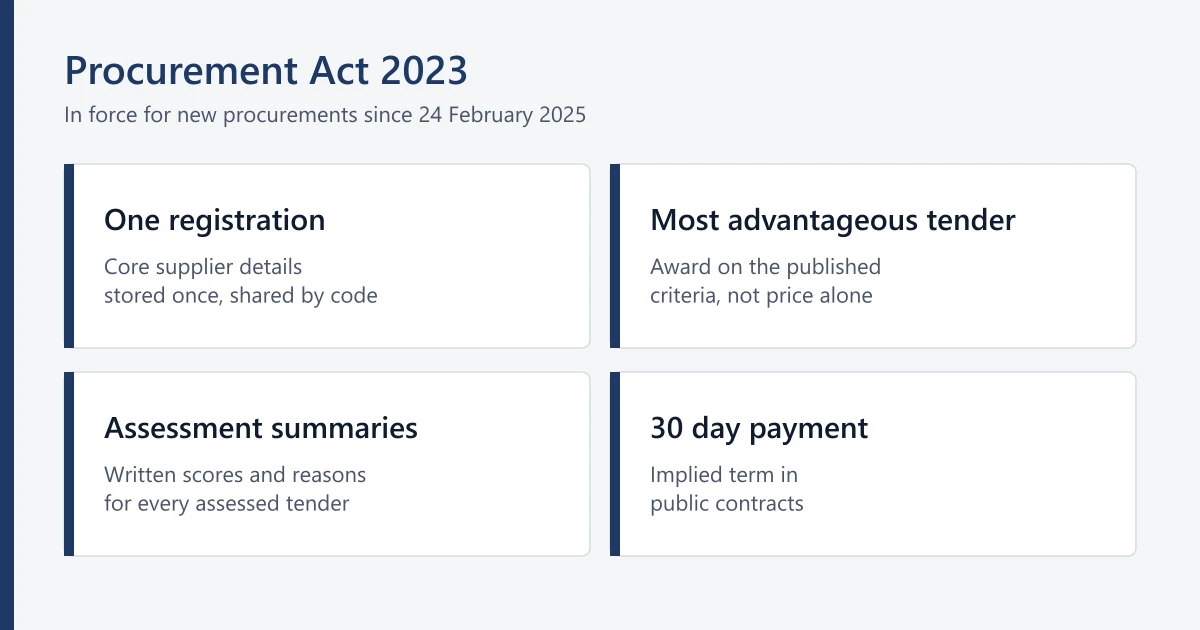
The Procurement Act 2023 has governed new public tenders in England, Wales and Northern Ireland since 24 February 2025. For a small IT supplier it brings rules you can use: register once, no pre-qualification stage on lower value contracts, limits on what buyers can demand, your scores in writing after every bid, and payment within 30 days.
What is the Procurement Act 2023?
The Procurement Act 2023 is the law that governs how UK public bodies buy. For a small IT firm it is a rulebook you can quote: what a buyer may demand from you, what feedback you are owed and how fast you must be paid. It has applied to new procurements since 24 February 2025.
The money it governs: £385 billion is spent through public procurement every year, on the government's own figure. Departments, the NHS, councils, schools, universities, housing organisations and the police all buy under it.
And the gap small firms face: on IT lots that publish bidder size, 17.5% of bids from small firms won, against 27.7% from larger firms. The Cabinet Office says the Act should "benefit prospective suppliers of all sizes, particularly small businesses, start-ups and social enterprises". Knowing the rules below by section number is how you use it.
The win rates are from our analysis of 149 IT lots in Find a Tender notices published 14 November 2025 to 28 February 2026. Contains public sector information licensed under the Open Government Licence v3.0. This guide is a plain summary, not legal advice.
When did the Procurement Act 2023 come into force?
The Act came into force on 24 February 2025. Any procurement started on or after that date follows it. Anything that began earlier stays under the old rules until it ends, so check which regime a tender is under before you rely on a right the Act gives you.
Cabinet Office guidance says procurements that began under the previous legislation "must continue to be procured and managed under that legislation". That includes older frameworks and the call-off contracts awarded from them.
Two quick checks:
- Read the notice code. On Find a Tender, Procurement Act notices are numbered UK1 to UK17. Older-regime notices have codes beginning with F, such as F02 for a contract notice.
- Scotland is separate. Find a Tender lists the Act for England, Wales and Northern Ireland, and lists separate Scottish regulations.
What changed for small IT suppliers?
Seven changes work in your favour: you register once, buyers must consider the barriers small firms face, they are limited in what they can demand, price need not win, you get your scores in writing, you are paid within 30 days, and frameworks reopen to new suppliers.
| Change | What you gain | Section |
|---|---|---|
| One registration | Enter your company details once and share them by code with every buyer | Guidance |
| Small firms | Buyers must have regard to the barriers small firms face and consider removing them | 12(4) |
| Limits on conditions | No audited accounts unless the law requires you to have them; no insurance in place before award | 22 |
| Most advantageous tender | The award goes on the published criteria, so strong answers can beat a lower price | 19 |
| Feedback | Your scores and the reasons, after every assessed tender | 50 |
| Payment | 30 day terms implied into public contracts | 68 |
| Open frameworks | A way in during a framework's life, not once every four years | 49 |
You will notice the registration first. Your details sit on the central digital platform, the Find a Tender service, and most buyers collect the tender-specific information through a Procurement Specific Questionnaire (PSQ).
Open frameworks matter most in IT. G-Cloud 15 is the first G-Cloud agreement run under the Act as an open framework, so it reopens to new suppliers during its four-year life.
What are the thresholds, and why do they matter?
The thresholds tell you which rules protect you. At or above the threshold, a contract gets the Act's full procedures: minimum tendering periods, assessment summaries and a standstill. From 1 January 2026 the line is £135,018 for central government and £207,720 for other authorities, including VAT.
The current figures, from PPN 023, apply to procurements that start between 1 January 2026 and 31 December 2027:
- Central government goods and services: £135,018
- Other authorities (councils, NHS bodies, housing, education): £207,720
- Works: £5,193,000
- Light touch contracts: £663,540
The figures include VAT. So a £115,000 contract plus VAT for a central government department is above the threshold, and the full rules apply.
What are the rules for below-threshold contracts?
Below the threshold, the door is wider. Under section 85, a buyer inviting tenders for a regulated below-threshold contract "may not restrict the submission of tenders by reference to an assessment of a supplier's suitability". There is no pre-qualification stage to pass before your tender is read.
Three more rules work for you at this level:
- You can see the work. If a buyer advertises a contract worth £12,000 or more (central government) or £30,000 or more (other authorities), including VAT, it must first publish a below-threshold tender notice on the central digital platform (section 87).
- Small firms are considered first. Before inviting tenders, the buyer must consider the barriers small firms may face and whether they can be reduced (section 86, as set out in the guidance).
- Deadlines must be fair. Time limits must be reasonable and the same for every supplier.
For a small IT firm building a public sector track record, this is where to start. Our guide to finding IT tenders on Find a Tender shows how to have these notices emailed to you.
How are tenders assessed, and what feedback do you get?
On the published criteria, and you see the marking. The contract goes to the "most advantageous tender". Every supplier whose tender was assessed then receives an assessment summary, and the buyer must wait eight working days after publishing the contract award notice before signing.
The assessment summary is the most valuable change for a firm learning to bid. Guidance says it gives your score for each criterion with an explanation and, if you lost, the winning tender's scores too. You see exactly where the marks went, and it arrives before the award notice, so you have the whole standstill period to read it.
The same section that sets the award rule is strict on compliance. A buyer must disregard a tender from a supplier that fails the conditions of participation, and may disregard one that breaches a procedural requirement such as the deadline or a word limit. A compliance matrix keeps you on the right side of both.
What about exclusions and the debarment list?
The Act has an exclusion regime and a published debarment list to keep out suppliers that pose a risk. For a sound small firm that is protection: you declare once, on the central digital platform, whether any exclusion grounds apply to your firm and its connected persons, and the PSQ confirms it.
Do it accurately. The Cabinet Office guide for suppliers describes a Procurement Review Unit that oversees the regime. It includes the Public Procurement Review Service, where you can raise concerns about a specific procurement or about late payment.
What should a small IT firm do now?
Four things, this week: register on Find a Tender, complete your supplier information, save searches for your services, and put your accounts, insurance certificates, policies and reference contracts in one folder. Then pick one below-threshold tender that fits and bid for it properly.
- Register. It is free, and the Cabinet Office lists what you need: Companies House number, address, the last two years of accounts if you have them, and details of connected persons.
- Save searches, and read the award notices for the buyers you want.
- For each tender, check the regime, the threshold and the pass or fail conditions before you write.
- Keep every assessment summary. Each one makes the next bid stronger.
Then let the first read be done for you. A bid pack shows what can knock you out and what the buyer will score, each with its page number, within one working day. Your first is free, one per company: see the sample bid pack.
Questions
When did the Procurement Act 2023 come into force?
The Procurement Act 2023 came into force on 24 February 2025. Procurements started on or after that date follow the Act. Procurements that began under the earlier rules, such as the Public Contracts Regulations 2015, must continue to be procured and managed under those rules, including call-offs from older frameworks.
Does the Procurement Act 2023 apply in Scotland?
The Find a Tender service lists the Procurement Act 2023 as the legislation for new procurements in England, Wales and Northern Ireland from 24 February 2025, and lists separate Scottish regulations. If you bid to a Scottish public body, check which rules the notice says apply and use Public Contracts Scotland.
What is the most advantageous tender?
It is the test for awarding a public contract under section 19 of the Act: the tender that satisfies the buyer's requirements and best satisfies the award criteria. Cabinet Office guidance says the wording clarifies that price need not always take precedence, which is good news for a small firm with strong answers.
What are the public procurement thresholds in 2026?
From 1 January 2026 the threshold for goods and services is £135,018 for central government authorities and £207,720 for other authorities, including VAT. Works contracts are £5,193,000. The figures are set out in PPN 023 and apply until 31 December 2027, when the next two-yearly revision is due.
Do public buyers have to pay within 30 days?
Yes. Section 68 of the Act implies a term into public contracts that sums due are paid within 30 days of the buyer receiving a valid, undisputed invoice, or of the payment falling due if that is later. A contract term that tries to override this is without effect. A few contract types, such as concessions, are excluded.
Sources
- Procurement Act 2023, legislation.gov.uk
- Public Procurement: Growing British industry, jobs and skills. Government response to consultation (CP 1541, March 2026)
- The Procurement Act 2023: a short guide for suppliers, Cabinet Office
- Guidance: Transitional and Saving Arrangements, Cabinet Office (updated 15 April 2026)
- Procurement Act 2023, section 12: covered procurement objectives
- Procurement Act 2023, section 20: competitive tendering procedures
- Procurement Act 2023, section 22: conditions of participation
- Procurement Act 2023, section 50: contract award notices and assessment summaries
- Procurement Act 2023, section 51: standstill periods
- Procurement Act 2023, section 68: implied payment terms in public contracts
- Procurement Act 2023, section 85: regulated below-threshold contracts, procedure
- Procurement Act 2023, section 87: regulated below-threshold contracts, notices
- PPN 023: 2026 Threshold Amounts, Cabinet Office
- Guidance: Below-Threshold Contracts, Cabinet Office (updated 13 July 2026)
- Guidance: Assessing Competitive Tenders, Cabinet Office (updated 17 August 2026)
- Find a Tender service (home page, and our analysis of notices for IT services, 14 November 2025 to 28 February 2026)
- G-Cloud 15 (RM1557.15) agreement page, Government Commercial Agency (an open framework under the Act)