G-Cloud explained for small IT firms (G-Cloud 15)
By Voin Srezoski. Published .
G-Cloud is the framework UK public bodies use to buy cloud hosting, software and support, and about £3 billion a year is expected to flow through it. G-Cloud 15 started on 6 August 2026. If you are on it, win the call-offs. If you are not, it reopens after 18 months, so prepare now and bid for open tenders meanwhile.
What is G-Cloud?
G-Cloud is the framework agreement UK public bodies use to buy cloud services. Suppliers with a place list their hosting, software and support, and buyers purchase from that list without running a full open tender. If you sell cloud services to the public sector, much of your market buys this way.
The numbers, from the government and the framework's own documents:
- £2.9 billion went through G-Cloud in the 2024 to 2025 financial year.
- About £3 billion a year of public sector cloud spend is expected to flow through G-Cloud 15, and about £14 billion over its term.
- About 90% of G-Cloud 15 suppliers are small and medium-sized enterprises.
- Over 4,000 suppliers and 50,000 services are listed.
So it is open to small firms, and it is crowded. A place gets you into the room. What you do next wins the work.
G-Cloud is run by the Government Commercial Agency (GCA). That is the new name of Crown Commercial Service (CCS) since 1 April 2026. Older documents still say CCS.
Which version is live now: G-Cloud 14 or G-Cloud 15?
G-Cloud 15. Its agreement page gives a start date of 6 August 2026. G-Cloud 14 expired on 28 October 2026, and GCA tells buyers to use G-Cloud 15 for new cloud requirements. If your G-Cloud 14 listing was your route to market, that route has closed for new work.
Existing G-Cloud 14 call-off contracts run on for their full terms. Work cannot be transferred from one agreement to the other.
Four things are new, according to GCA and the GOV.UK announcement of 10 August 2026:
- It runs under the Procurement Act 2023. G-Cloud 14 was a framework under the Public Contracts Regulations 2015.
- It is an open framework. It runs for four years and reopens to new suppliers after 18 months and again after 36 months.
- It consolidates three agreements: G-Cloud 14 lots 1 to 3, G-Cloud 14 lot 4 and Cloud Compute 2.
- Suppliers are assessed on "quality, technical capability and price".
On dates: the agreement page describes a four-year agreement from 6 August 2026 and shows an end date of 5 February 2028. The tender documents describe an open framework made up of three successive frameworks lasting four years in total, which fits the first one ending when the framework first reopens, 18 months in.
What are the G-Cloud 15 lots?
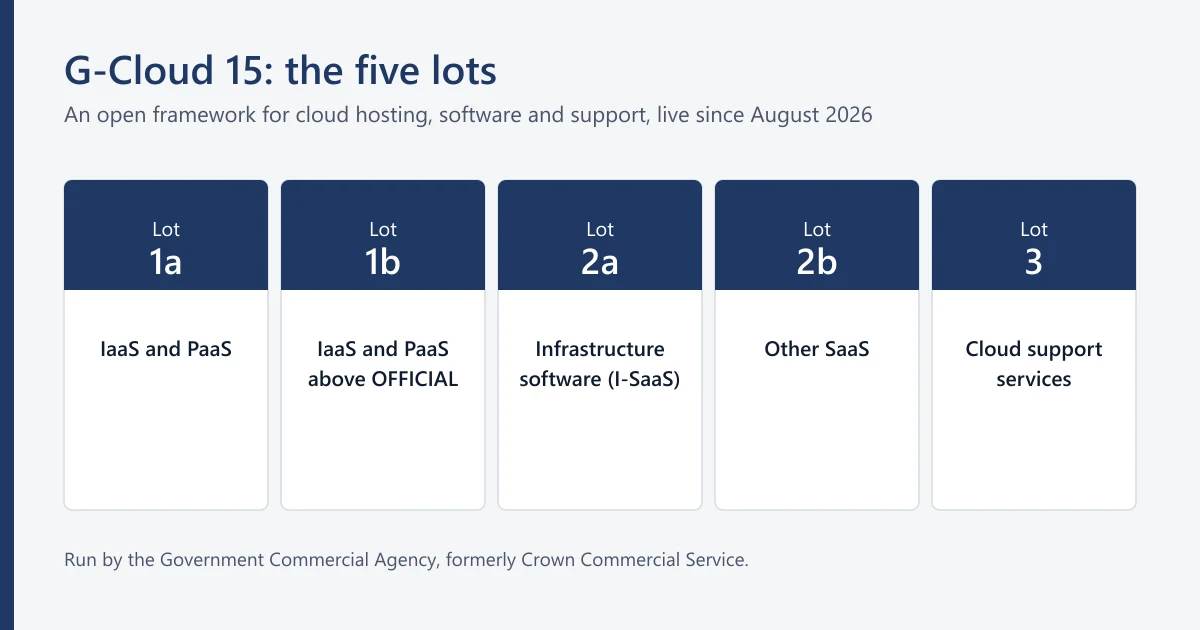
Five lots: two for infrastructure and platform services, two for software as a service, and one for cloud support. You can tender for one lot or several, and there is no limit on the number of suppliers in each. Pick the lots that match what you already sell.
| Lot | Name | What it covers |
|---|---|---|
| 1a | IaaS and PaaS | Platform or infrastructure services for processing and storing data, running software or networking |
| 1b | IaaS and PaaS above OFFICIAL | The same, for work above the OFFICIAL security classification |
| 2a | Infrastructure software (I-SaaS) | Cloud-based systems infrastructure software |
| 2b | Other SaaS | Applications hosted in the cloud |
| 3 | Cloud support services | Additional services to help set up and maintain cloud software or hosting |
A small IT firm will usually look first at lot 2b if it sells its own software, or lot 3 if it sells implementation, migration, managed services or support around someone else's cloud platform.
How do buyers buy through G-Cloud?
By two routes, and each rewards different preparation. In an award without competition your listing does the selling. In a competitive selection you write a tender response against other shortlisted suppliers. Call-off contracts under G-Cloud 15 can run for up to 60 months, so each win can be long.
Award without competition. The buyer filters the catalogue against its requirements, checks exclusions and awards on lowest price. Nobody asks you a question first. Your service description and your published price are the whole pitch, so write them for the filters a buyer will use.
Competitive selection. The buyer shortlists suppliers, issues an invitation to tender and awards to the most advantageous tender. This is a tender in miniature, with documents, criteria and a deadline. Everything in our guide on how to write a tender response applies.
Who can buy: central government, local authorities, health, education, charities, blue light services, devolved administrations and British overseas territories.
How does a small IT firm get onto G-Cloud 15?
You tender for a place when the framework is open. The first competition has closed. The next chance is the reopening, due 18 months after the 6 August 2026 start, which puts it in early 2028. Use the time: firms that arrive with their documents ready will not be writing them against a deadline.
The first G-Cloud 15 competition ran as an open procedure under the Procurement Act 2023. Its tender documents show what applicants submitted:
- a technical ability certificate for each lot applied for;
- a quality questionnaire;
- a financial viability risk assessment;
- a carbon reduction plan, for lots 1a and 1b only;
- pricing for the services offered, which becomes part of the framework contract.
This is more than earlier versions asked. Experience of applying to G-Cloud 13 or 14 will not carry you. GCA will publish the documents for the reopening with its tender notice, so read those when they appear.
To be ready: register on the central digital platform, keep two years of accounts to hand, and write clear service definitions and pricing now. Our guide to finding tenders on Find a Tender shows how to have the notice emailed to you.
What are the obligations once you are on the framework?
Three, and each has a cost you should price in. You send GCA management information every month. You pay a management charge, a fixed percentage of the invoiced value of every contract won through the framework. And you are held to the prices and terms in your framework contract.
The percentage is stated in the tender notice and the framework award form, so check it before you set your prices. A successful supplier must sign and return the framework award form within 8 working days of being asked.
GCA's own words on revenue: "we do not guarantee any business through this framework." The place is the start, not the sale.
Is G-Cloud worth it for a small IT firm?
Yes, if public bodies already buy what you sell as a cloud service and you can describe and price it clearly. About 90% of the suppliers are small and medium-sized firms, and about £3 billion a year is expected to flow through it. Winning depends on being easy to find and compare.
What it takes:
- A listing that matches how buyers search. With over 50,000 services listed, a vague description is invisible.
- Prices you can hold. In an award without competition, the lowest price that meets the need wins.
- The ability to answer an invitation to tender quickly. Competitive selections go to shortlisted suppliers with a deadline.
- Monthly reporting.
If you sell bespoke development or on-premises services, check the lots first. Your market may sit in open tenders instead.
What can you do if you are not on G-Cloud 15?
Bid for open tenders now and prepare for the reopening. Open tenders need no framework place. You can also work as a subcontractor to a supplier that holds a place. The reopening is over a year away, and you do not have to wait for it.
Framework call-offs are a large part of the market: in a three-week sample of Contracts Finder notices we analysed, 193 of 257 IT services notices were call-offs under frameworks. The rest is open to you today, and below-threshold contracts have the lightest entry rules, as our Procurement Act 2023 guide explains.
When you find an open tender, a bid pack tells you within one working day what can knock you out and what the buyer will score, each with its page number. Packs are generated by AI and each quote is checked against the page it cites. Your first is free, one per company: see the sample bid pack, built from a live £140,000 IT tender. Contains public sector information licensed under the Open Government Licence v3.0.
Questions
What is G-Cloud?
G-Cloud is a UK public sector framework agreement for cloud services. Suppliers awarded a place list their cloud hosting, software and support services, and public bodies buy from them through call-off contracts without running a full open tender each time. It is managed by the Government Commercial Agency, formerly Crown Commercial Service.
Is G-Cloud 14 still live?
No. The Government Commercial Agency's agreement page states that G-Cloud 14 expired on 28 October 2026 and that buyers should use G-Cloud 15. Call-off contracts signed under G-Cloud 14 before that date remain in effect for their full terms, but work cannot be transferred to G-Cloud 15.
When can new suppliers join G-Cloud 15?
G-Cloud 15 is an open framework that runs for four years from 6 August 2026 and reopens after 18 months and again after 36 months. On those dates the first reopening falls in early 2028. Save a Find a Tender search now so the tender notice from the Government Commercial Agency reaches you.
How do buyers award contracts on G-Cloud 15?
There are two routes. Award without competition suits straightforward needs that an existing catalogue service meets: the buyer filters services and awards on lowest price. Competitive selection suits complex or tailored needs: the buyer invites shortlisted suppliers to tender and awards to the most advantageous tender.
Does a place on G-Cloud guarantee work?
No, and the tender documents say so. A place makes you eligible to be found and bought from. The work is won afterwards: by your service descriptions and pricing in an award without competition, and by a written tender response in a competitive selection. Prepare for both.
Sources
- G-Cloud 15 (RM1557.15) agreement page, Government Commercial Agency
- G-Cloud 14 (RM1557.14) agreement page, Government Commercial Agency
- G-Cloud relaunches with biggest upgrade in its history, GOV.UK news (10 August 2026)
- RM1557.15 G-Cloud 15, Attachment 1: About the framework (open framework), version 2.0
- Applying to the G-Cloud framework (G-Cloud 14 guide, withdrawn 20 November 2025), GOV.UK
- Contracts Finder (our analysis of a three-week sample of IT services notices)