How to write a tender response: a step-by-step guide
By Voin Srezoski. Published .
To write a tender response that can win, spend the first days finding what can knock you out and what earns marks, before you write a line. Read every document, list each requirement, confirm you pass the pass or fail conditions, then plan and write the scored answers to the published weightings and submit early.
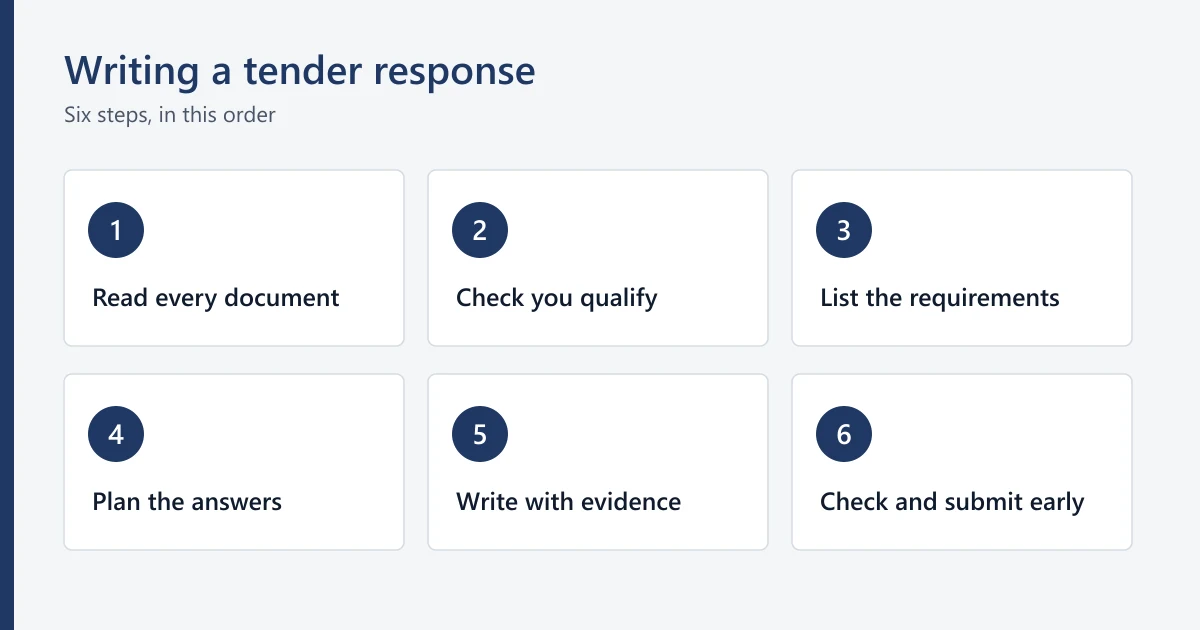
How to write a tender bid: what are the steps?
Six steps: read everything, check you qualify, list every requirement, plan each answer to the scoring, write with evidence, then check and submit early. The first three decide whether your bid can be scored at all. Do them in the first days and the writing has room to be good.
A tender lands. You have a business to run and a clock running:
- 30 days is the typical time an IT tender gives you from publication to deadline. One in four gives under 25.
- 70% of the score in the typical IT tender is quality, not price.
- One failed pass or fail requirement is enough for the buyer to set your whole bid aside.
So the plan is simple. Find what can knock you out. Find where the marks are. Spend your hours there.
| Step | What you have at the end |
|---|---|
| 1. Read | Every document and every date, in one list |
| 2. Qualify | A bid or no-bid decision you can defend |
| 3. List requirements | A compliance matrix: nothing missed |
| 4. Plan | An outline for each scored answer |
| 5. Write | Answers, pricing and forms |
| 6. Check and submit | A complete bid, sent early |
Find a Tender figures: our analysis of notices for IT services published 14 November 2025 to 28 February 2026. Typical means the median. Contains public sector information licensed under the Open Government Licence v3.0. The legal points below are from the Procurement Act 2023.
What should you read before you write anything?
Read the tender notice and every attached document before you draft a word, so that nothing surprises you in week three. The notice often holds facts the documents never repeat. Write down three things first: the deadline for questions, the submission deadline and how the bid must be sent.
The deadline for questions comes sooner than you think. In our three sample tenders it fell 12, 14 and 25 days before the deadline for bids. Miss it and you write your answers on guesses.
Under section 21 of the Act, a buyer may not invite tenders unless the notice or documents contain "information sufficient to allow suppliers to prepare such a tender". If the scoring scale or the contract terms are missing, ask. Our guide to the invitation to tender covers what each document is for.
Check for updates too. Buyers publish amendments and answers to other suppliers' questions, and one answer can change a requirement. Always work from the latest version.
How do you decide whether to bid at all?
Check the pass or fail conditions before anything else. Fail one and the buyer must disregard your tender, however good the answers. A short check here can save you thirty days. If you pass, weigh the contract's value and fit against the hours the bid will take.
Conditions of participation cover legal and financial capacity and technical ability (section 22). In IT tenders that usually means insurance levels, certifications such as Cyber Essentials, financial tests and reference contracts. The Act is on your side here. A buyer may not:
- require audited accounts from a firm that is not legally required to have them;
- require insurance to be in place before the contract is awarded;
- require that you have already held a contract with a particular contracting authority;
- require a qualification without allowing equivalents.
You also need to be registered on the central digital platform (the Find a Tender service) and to share your details with the buyer. It is free. Do it on day one, so it cannot hold up your submission. See what a PSQ asks.
How do you make sure nothing is missed?
Build a compliance matrix: one row per requirement, in the buyer's words, with its document and page, whether it is pass or fail or scored, its weighting, any word limit and the evidence needed. Then every later step has a checklist, and no line can quietly disappear.
Requirements hide. One of our sample tenders, worth £140,000, had 86 requirements across six documents, 62 of them mandatory. One mandatory line appeared in the notice and nowhere in the documents. Our compliance matrix guide shows the real rows.
This is the step a bid pack does for you. Bid Writing Pack reads the whole tender with AI, checks each quote against the page it cites, and sends the matrix, a one-page bid or no-bid brief and an answer outline within one working day. Your first pack is free, one per company: see the sample bid pack.
How do you plan and write answers that score?
Plan each answer around the criterion it will be marked against, give the most words to the criteria with the most weight, and back every claim with evidence. Evaluators can only award marks for what the criterion asks. Mirror its structure and you make the marks easy to give.
Section 23 requires the buyer to describe how tenders will be assessed and to show the relative importance of each criterion. Use it:
- Split the question. If it asks for approach, team and risks, write three headed parts.
- Lead with the answer. Say what you will do, then how, then the proof.
- Use evidence you can back up. Named tools, real timescales, results from past contracts, CVs, certificates.
- Write to the scoring scale. If the top band needs "detailed evidence", a general statement will not reach it.
- Follow the weighting. A 40% question deserves eight times the care of a 5% one.
Do not leave social value until last. Central government policy gives it at least 10% of the marks in above-threshold procurements, and other buyers set their own figure.
Price carries marks too. Complete the buyer's pricing document exactly as issued. A buyer may disregard a price it considers abnormally low, but only after giving you a reasonable opportunity to show that you can deliver at that price.
What do you check before you submit?
Check four things: every pass or fail item is answered and evidenced, every scored answer is inside its word or page limit, every form is completed and signed as instructed, and the submission method matches the instructions. Then submit early, because a late tender can be disregarded.
Go through the matrix row by row and mark each one done. The failures that cost contracts are small: a declaration left unsigned, an attachment in the wrong format, an answer over the limit, a portal upload started ten minutes before the deadline. Cabinet Office guidance names late submission and exceeding a word count as examples of procedural breaches.
What happens after you submit?
You get your scores in writing. The buyer assesses the tenders, sends each assessed supplier an assessment summary, publishes a contract award notice, then waits eight working days before signing. Win or lose, the summary shows where your marks went, which makes your next bid stronger.
Under section 50, the summary must reach you before the contract award notice is published. Cabinet Office guidance says it sets out your score against each criterion with an explanation and, if you lost, the winning tender's scores. The standstill in section 51 starts on the day the award notice is published.
Save your answers and evidence in one place. The next tender will ask many of the same questions, and you will start it days ahead.
Questions
How long do you get to write a tender response?
The typical IT tender gives 30 days from publication to deadline, and one in four gives under 25, on our analysis of Find a Tender notices. The legal minimum under section 54 of the Procurement Act 2023 is 25 days in the common case and 10 in several others. The deadline is in the tender notice.
What is the most advantageous tender?
It is the basis on which public contracts are awarded under the Procurement Act 2023. Section 19 defines it as the tender that satisfies the buyer's requirements and best satisfies the award criteria. Cabinet Office guidance says the wording makes clear that price need not always come first, so strong answers can beat a lower price.
Can a tender be rejected for going over the word limit?
Yes. Section 19 of the Procurement Act 2023 lets a buyer disregard a tender that breaches a procedural requirement set out in the tender notice or tender documents. Cabinet Office guidance gives late submission and exceeding a prescribed word count as examples. Treat every limit and format rule as pass or fail.
Do you get feedback if you lose a tender?
Yes, for contracts awarded under the Procurement Act 2023 after a competitive procedure. Section 50 requires the buyer to send each supplier whose tender was assessed an assessment summary before the contract award notice. It shows your scores with reasons and the winning tender's scores, so you know exactly where the marks went.
How do I write a tender response with no public sector experience?
Use your private sector work as evidence and answer exactly what is asked. A buyer may not require that you have held a contract with a particular contracting authority. Start with lower value contracts: below the thresholds, buyers may not use a separate suitability stage to stop you submitting a tender.
Sources
- Find a Tender service: notices for IT services, 14 November 2025 to 28 February 2026 (our analysis)
- Procurement Act 2023, section 19: award of public contracts following a competitive tendering procedure
- Procurement Act 2023, section 21: tender notices and associated tender documents
- Procurement Act 2023, section 22: conditions of participation
- Procurement Act 2023, section 23: award criteria
- Procurement Act 2023, section 50: contract award notices and assessment summaries
- Procurement Act 2023, section 51: standstill periods
- Procurement Act 2023, section 54: time limits
- Procurement Act 2023, section 85: regulated below-threshold contracts
- Guidance: Assessing Competitive Tenders, Cabinet Office (updated 17 August 2026)
- Guidance: Assessment Summaries, Cabinet Office (updated 17 August 2026)
- Central Digital Platform factsheet, Cabinet Office