Compliance matrix: what it is, with a worked example
By Voin Srezoski. Published .
A compliance matrix stops a bid being thrown out over a line nobody saw. It lists every requirement in a tender, one per row, in the buyer's words, with the document and page, whether it is pass or fail or scored, its weighting and the evidence needed. You plan from it and check the finished bid against it.
What is a compliance matrix?
A compliance matrix is the table that stops your bid being thrown out over a missed line. Every requirement in the tender gets one row: what the buyer asks, where it says so, and whether it is pass or fail or scored. You build it before writing and check the bid against it before sending.
The risk it removes is written into the law. Under section 19 of the Procurement Act 2023, a buyer must disregard a tender from a supplier that does not satisfy the conditions of participation, and may disregard a tender that breaches a procedural requirement. Cabinet Office guidance gives a late submission and an answer over the word count as examples.
And the requirements are never in one place. Here is what three live UK IT tenders held when we broke them down in November 2026:
- A £140,000 cyber security tender: 86 requirements in six documents, 62 of them mandatory.
- A £100,000 finance system tender: 192 rows, with about 97 numbered requirements on 26 pages, each scored under a weighting printed on a different page.
- A £525,000 licensing tender: 82 rows, plus 68 clarification answers that changed who could bid.
Read that straight through after a day of client work and something gets missed. A matrix makes missing it hard.
What columns does a compliance matrix need?
Ten columns do the job: an ID, the source document, the page or section, the requirement in the buyer's words, mandatory or scored, the question reference, the weighting, any word or page limit, the evidence required and the deadline. Together they let anyone check any row against the tender in seconds.
| Column | What it gives you |
|---|---|
| ID | A way to refer to a requirement in a meeting or an email |
| Source and page | Proof: open the document and check it |
| Requirement | The buyer's own words, which are what you are assessed against |
| Type | What can knock you out, and what earns marks |
| Evidence | What to supply, with any limit, weighting or deadline |
Two rules separate a matrix you can rely on from a summary:
- Quote, do not paraphrase. A paraphrase can quietly turn a "must" into a "should".
- Cite the page. A row nobody can trace is a row nobody can trust.
What does a compliance matrix look like for a real tender?
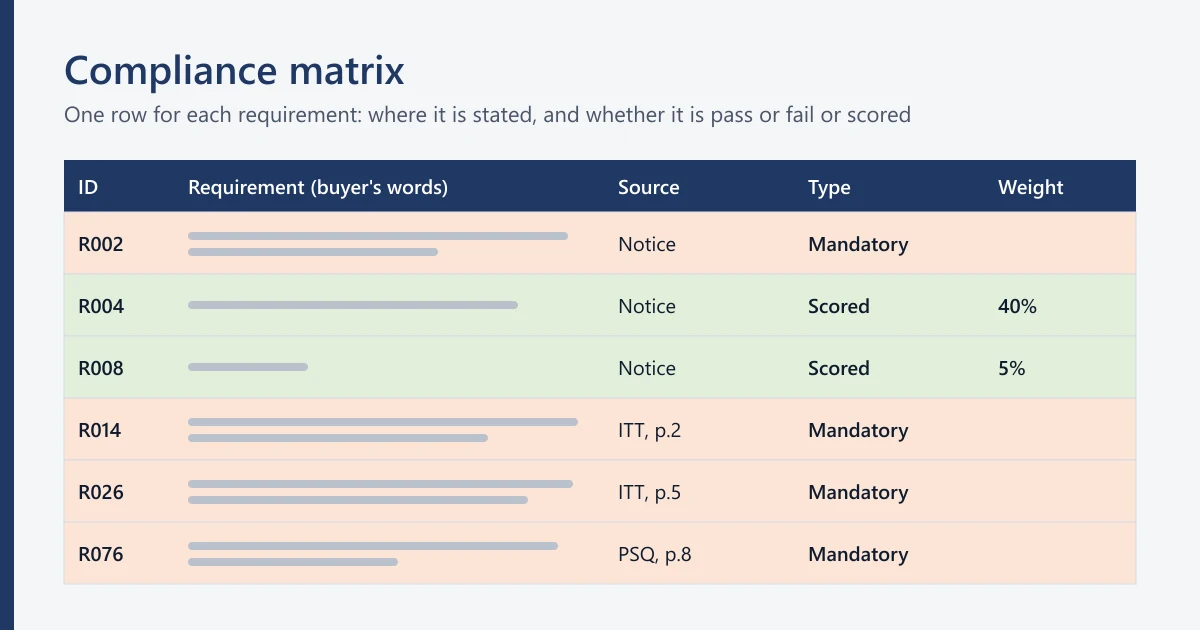
Here are six rows from the matrix in our sample bid pack. The tender is live: a £140,000 managed detection and response service for a Cambridge housing association, Find a Tender notice 108226-2026. Three of the six hold a trap.
| ID | Requirement (buyer's words) | Source | Type | Evidence or note |
|---|---|---|---|---|
| R002 | "Must be able to cover Windows, IOS , and Android mobile end point." | Notice, selection criteria | Mandatory | Stated only in the notice, not in the tender documents |
| R004 | "Functionality matched against the specification" | Notice, award criteria | Scored, 40% | No evidence format specified |
| R008 | "Social Value" | Notice, award criteria | Scored, 5% | Pledges set out in the buyer's social value document |
| R014 | "CHS's Primary Contact must receive tender responses at the address detailed by key date 9th December 2026." | ITT, p.2 | Mandatory | Complete response by email |
| R026 | "The form of declaration is the Non-Collusion Certificate and must be signed and returned as an original hard copy with their tender response." | ITT, p.5 | Mandatory | No postal address is given: ask the buyer |
| R076 | "Please provide details of three reference contracts ... in the last three years" | PSQ, p.8 | Mandatory | Customer, contact, dates, value and relevance for each |
The requirement column is the buyer's text as written, including the buyer's own spelling. Contains public sector information licensed under the Open Government Licence v3.0.
What the matrix caught:
- R002 is only in the notice. A mandatory requirement to cover three mobile platforms sits in the Find a Tender notice and nowhere in the documents. Read only the attachments and you never see it.
- R014 and R026 conflict. One page says to email the response. Another demands an original signed hard copy, with no postal address. Side by side, that becomes a question to the buyer, asked before the deadline for questions.
- R004 carries 40% of the marks with no stated format. You now know where to spend your hours and what to ask.
Read all 86 rows and download the workbook on the sample bid pack page. It is a sample, not client work, and we have no connection with the buyer.
How do you build a compliance matrix, step by step?
Collect every document, read each one in full, and add a row each time the buyer requires, scores or asks for something, with the exact words and the page. Then classify each row, add weightings and limits, and list what is unclear. You finish knowing exactly what the tender demands.
- List the documents. Include the tender notice itself, every attachment, and any amendments or published answers. Regulation 18 of the Procurement Regulations 2024 requires the notice to carry the award criteria or a summary, any conditions of participation, and how and by when tenders must be submitted.
- Read and extract. Look for "must", "shall", "required", "will be excluded", "please provide", word limits, forms and dates.
- Classify. Mark each row mandatory, scored or information. If you cannot tell, that is a question for the buyer.
- Add the scoring. Put each weighting next to the question it applies to.
- Add the evidence. A certificate, a signed form, a 500-word answer, three references.
- List the gaps. Conflicts and missing information become clarification questions. Anything you cannot meet feeds the decision on whether to bid.
Our guide on how to write a tender response covers what to do next.
What is the difference between mandatory and scored requirements?
A mandatory requirement is pass or fail: miss it and your tender can be set aside without being scored. A scored requirement earns marks against the award criteria. Knowing which is which tells you where proof is enough and where your best writing has to go.
Mandatory rows come in two kinds. Conditions of participation test the supplier: under section 22 they cover legal and financial capacity or technical ability, and they are usually collected through the Procurement Specific Questionnaire. Procedural requirements test the submission: deadlines, formats, signed forms and word limits.
Scored rows come from the award criteria. Section 23 says the buyer must describe how tenders will be assessed and must state whether failing a criterion would disqualify a tender. Watch for that: a scored question with a minimum score is partly pass or fail. Put it in the row.
What does a compliance matrix save you?
It saves the bid, and often the month. With every pass or fail condition on one page, you can see quickly whether you qualify. If you do not, you have saved the weeks the bid would have taken. If you do, you write knowing nothing can ambush you at submission.
It also buys time to ask. In our three sample tenders, the deadline for questions to the buyer fell 12, 14 and 25 days before the deadline for bids. A matrix built in the first days finds the conflicts while you can still ask about them.
Is there a compliance matrix template you can use?
Yes: use a real one. Download the Excel workbook from our sample bid pack and copy its column layout, its key dates sheet and its list of source documents. A template filled with a live tender shows you what good looks like faster than an empty grid.
Or have yours built for you. Bid Writing Pack generates the matrix with AI and checks each quote against the page it cites, then sends it with a one-page bid or no-bid brief and an answer outline within one working day. Your first pack is free, one per company. Start on the homepage.
Questions
What is a compliance matrix in a tender?
It is a table of every requirement the buyer has set, one row each, with the source document and page, whether the requirement is mandatory or scored, the weighting, any word or page limit and the evidence you need to supply. It is how bidders make sure nothing is missed before they submit.
Is a compliance matrix a legal requirement?
No, it is your own working tool. The reason to keep one is in section 19 of the Procurement Act 2023: a buyer must disregard a tender from a supplier that fails the conditions of participation, and may disregard one that breaches a procedural requirement. The matrix is how you avoid both.
What is the difference between a compliance matrix and a bid plan?
A compliance matrix records what the buyer requires and where it says so. A bid plan records who in your firm will do what and by when. The matrix comes first, because you cannot assign work until you know every requirement, form and deadline in the tender.
How many requirements does a typical tender have?
More than most firms expect. Our three sample matrices, built from live UK IT tenders worth £100,000 to £525,000, have 82, 86 and 192 rows. In the 86-row tender, 62 rows were mandatory and they were spread across six documents. Counting them is the first job a matrix does.
Sources
- Procurement Act 2023, section 19: award of public contracts following a competitive tendering procedure
- Procurement Act 2023, section 22: conditions of participation
- Procurement Act 2023, section 23: award criteria
- The Procurement Regulations 2024, regulation 18: tender notices, open procedure
- Guidance: Assessing Competitive Tenders, Cabinet Office (updated 17 August 2026)
- Find a Tender notice 108226-2026: Managed Detection and Response (MDR) Service