Invitation to tender (ITT): what it is and what is in it
By Voin Srezoski. Published .
An invitation to tender (ITT) is the buyer's pack of documents asking suppliers to bid, and it starts a clock: the typical IT tender allows 30 days. Know what each document is for and you can find what can knock you out and what earns marks in the first days, and spend the rest writing.
What is an invitation to tender?
An invitation to tender, or ITT, is the pack of documents a buyer issues to ask suppliers to bid. It sets what the buyer wants, the rules of the competition, how bids are scored and when everything is due. From the day it is published, a clock is running against you.
What that clock looks like for IT:
- 30 days is the typical time from publication to deadline. One in four IT tenders gives under 25.
- 12, 14 and 25 days before the bid deadline: that is when the deadline for questions fell in three live tenders we broke down. The time to query anything is shorter than the time to bid.
- 86 requirements in six documents, 62 of them mandatory, in one of those tenders, worth £140,000.
An ITT is a rulebook as much as a request. The G-Cloud 15 ITT, a current government example, says its documents "contain the competition rules which you must follow", and that failure to follow them "may result in your exclusion from the competition, or your tender being disregarded".
Find a Tender figures: our analysis of notices for IT services published 14 November 2025 to 28 February 2026. Typical means the median. Contains public sector information licensed under the Open Government Licence v3.0.
Is "invitation to tender" still the right term under the Procurement Act 2023?
Buyers still say it, but the Act calls the same thing a "tender notice" and "associated tender documents". Knowing both names stops you missing half the pack: Cabinet Office guidance says that in an open procedure "the tender notice is the 'invitation to tender'".
Section 21 of the Act defines the two pieces:
- The tender notice states that a contracting authority intends to award a public contract. Publishing it starts the competition.
- An associated tender document supplements the notice. The guidance gives the specification, the award criteria and the contract terms as examples.
Buyers bridge the old and new wording themselves. The G-Cloud 15 pack says its documents "form the Invitation to Tender (ITT)" and that each one "is an associated tender document for the purpose of section 21". Tender documents, tender pack, ITT: the same thing.
In a multi-stage competition, which the Act calls a competitive flexible procedure, the notice may first invite requests to participate. The buyer then issues an invitation to tender to the shortlisted suppliers.
What documents are in an ITT pack?
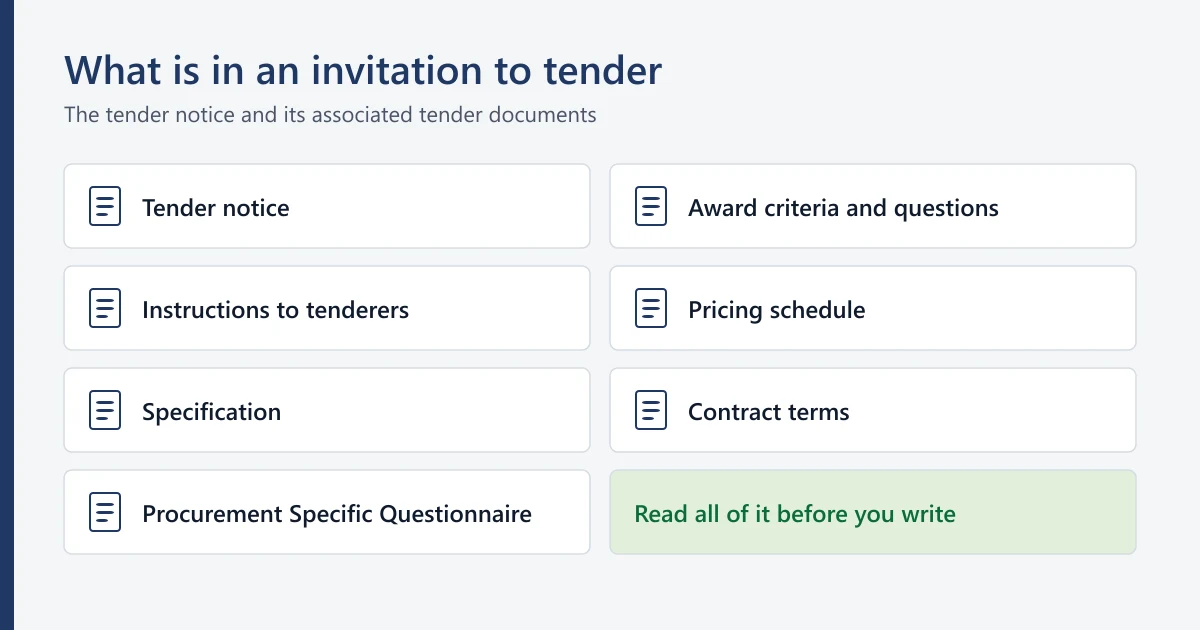
Usually seven kinds: the tender notice, instructions to tenderers, the specification, a Procurement Specific Questionnaire, the award criteria and quality questions, a pricing document and the contract terms, plus forms to sign. Each one can hold a requirement that knocks you out, so each one has to be read.
| Document | What it tells you | What to look for |
|---|---|---|
| Tender notice | The contract, value, deadline, award criteria | Requirements that appear nowhere else |
| Instructions to tenderers | The competition rules | Deadlines, format, word limits, how to submit |
| Specification | What the buyer wants delivered | Every "must" and "shall" |
| Procurement Specific Questionnaire | Whether you qualify | Pass or fail conditions |
| Quality questions and pricing | How marks are won | Weightings and scoring scale |
The law is on your side if something is missing. Under section 21 a buyer may not invite tenders unless the notice and documents contain "information sufficient to allow suppliers to prepare such a tender". No scoring scale or no contract terms is a fair question to put to the buyer.
Our sample tender shows how much a small pack holds. Its compliance matrix has 86 rows from six source documents, including the notice, an ITT document and a Procurement Specific Questionnaire. One mandatory requirement sat in the notice and nowhere else. See it on the sample bid pack page.
What must the tender notice tell you?
The Procurement Regulations 2024 require a tender notice to give you what you need to decide quickly: the subject and estimated value of the contract, how and by when to submit, the award criteria, any conditions of participation and where the documents are. Read it first, and read it closely.
Regulation 18 requires, among other things:
- "the contract subject-matter" and "the estimated value of the public contract";
- "how tenders may be submitted and the date by when they must be submitted";
- "the award criteria, or a summary of the award criteria";
- "a description of any conditions of participation";
- whether the contract is divided into lots, and any options to extend or renew;
- whether the contract may be suitable for small and medium-sized enterprises;
- the titles of the associated tender documents and whether they are attached or linked;
- the estimated date of award.
Some buyers put weightings or selection criteria in the notice fields and never repeat them in the documents. A bidder who skips the notice misses them.
What is the tender process after an ITT is issued?
It runs in a fixed order: the notice and documents are published, suppliers ask questions, tenders go in by the deadline, the buyer assesses them, each assessed supplier gets its scores, a contract award notice is published, a standstill passes and the contract is signed. Knowing the order tells you what to do when.
- Publication. The tender notice goes on Find a Tender with the documents attached or linked.
- Clarification. Suppliers send questions by the date the buyer sets. Buyers usually publish the answers for all bidders, and may amend the documents.
- Submission. By the deadline, in the format and through the channel the ITT specifies.
- Assessment. The buyer checks the conditions of participation and scores tenders against the award criteria.
- Assessment summaries. Your scores and the reasons, sent before the award notice (section 50).
- Contract award notice and standstill. The buyer may not sign until eight working days after publishing the notice (section 51).
- Contract. The contract is signed and a contract details notice follows.
An open procedure does this in a single stage. A competitive flexible procedure can add shortlisting, negotiation, presentations or demonstrations.
How long do you have to respond to an ITT?
Thirty days in the typical IT tender, and under 25 in one in four. The law sets a floor of 25 days in the most common case: electronic submission with all the documents published at once. Plan on the short end, so a tight deadline never catches you out.
| Situation | Minimum tendering period (section 54) |
|---|---|
| Electronic submission, all documents provided with the notice | 25 days |
| Electronic submission, documents not all provided at once | 30 days |
| A qualifying planned procurement notice was published earlier | 10 days |
| Urgency, or award by reference to a dynamic market | 10 days |
| Light touch contract | No minimum |
These minimums apply to above-threshold public contracts. For below-threshold contracts, section 87 requires only that time limits are reasonable and the same for every supplier.
What is the difference between an ITT, a PSQ and an RFQ?
They ask for different things, and mixing them up wastes days. An ITT invites a full tender: your method, your price and your acceptance of the contract. A PSQ checks the supplier, not the offer. An RFQ, or request for quotation, is a simpler request, mostly about price for a defined requirement.
Only some of these words are in the legislation. "Tender notice", "associated tender documents" and "conditions of participation" are terms in the Procurement Act 2023. ITT, RFQ and RFP (request for proposal) are customary labels, used loosely. Ignore the label. Read what the document asks you to submit and how it says the contract will be awarded.
What should you do first when an ITT arrives?
Before you write anything: download every document, note the deadline for questions and the deadline for bids, read the pass or fail conditions and list each requirement with its source. Then decide whether to bid. Do this in the first two days and the other four weeks go on answers that score.
- Save the notice and all attachments, and check the notice page for amendments.
- Put the key dates in a calendar: questions, submission, any presentation, award.
- Read the PSQ and the conditions of participation. If you fail one, stop.
- Build a compliance matrix.
- Send clarification questions early.
- Plan and write. Our guide on how to write a tender response takes it from there.
Steps 1 to 4 are what a bid pack does for you. Paste the tender link into Bid Writing Pack and within one working day you have the matrix, a one-page bid or no-bid brief and an answer outline. Packs are generated by AI and each quote is checked against the page it cites. Your first is free, one per company: start on the homepage.
Questions
What does ITT stand for?
ITT stands for invitation to tender. It is the pack of documents a buyer issues to invite suppliers to submit a tender for a contract. It normally includes instructions, a specification, the award criteria and questions, a pricing document, the contract terms and, in UK public procurement, a Procurement Specific Questionnaire.
What is the difference between a tender notice and an invitation to tender?
The tender notice is the formal notice a public buyer publishes on Find a Tender to start a competitive procedure. Cabinet Office guidance says that in an open procedure the tender notice is the invitation to tender. In everyday use, ITT means the notice together with the documents attached to it. Read both.
What is a tender process?
A tender process is the sequence a buyer follows to award a contract by competition: publish the tender notice and documents, answer suppliers' questions, receive tenders by the deadline, assess them against the published criteria, send assessment summaries, publish a contract award notice, observe a standstill period and sign the contract.
Do you have to pay to get tender documents?
No, not for UK public contracts under the Procurement Act 2023. Cabinet Office guidance says associated tender documents must generally be provided free of charge and electronically. The Find a Tender service is also free to search and to register on, so there is no need to pay a third party for the documents.
How long does a buyer give you to respond to an ITT?
The typical IT tender gives 30 days from publication to deadline, and one in four gives under 25, on our analysis of Find a Tender notices. The legal minimum under section 54 of the Procurement Act 2023 is 25 days in the common case. The deadline for questions falls earlier still.
Sources
- Procurement Act 2023, section 21: tender notices and associated tender documents
- Procurement Act 2023, section 20: competitive tendering procedures
- Guidance: Competitive Tendering Procedures, Cabinet Office (updated 13 July 2026)
- The Procurement Regulations 2024, regulation 18: tender notices, open procedure
- Procurement Act 2023, section 54: time limits
- Procurement Act 2023, section 50: contract award notices and assessment summaries
- Procurement Act 2023, section 51: standstill periods
- RM1557.15 G-Cloud 15, Attachment 1: About the framework (an example of a current ITT)
- Find a Tender service: notices for IT services, 14 November 2025 to 28 February 2026 (our analysis), and notice 108226-2026