What is a bid writer, and when do you need one?
By Voin Srezoski. Published .
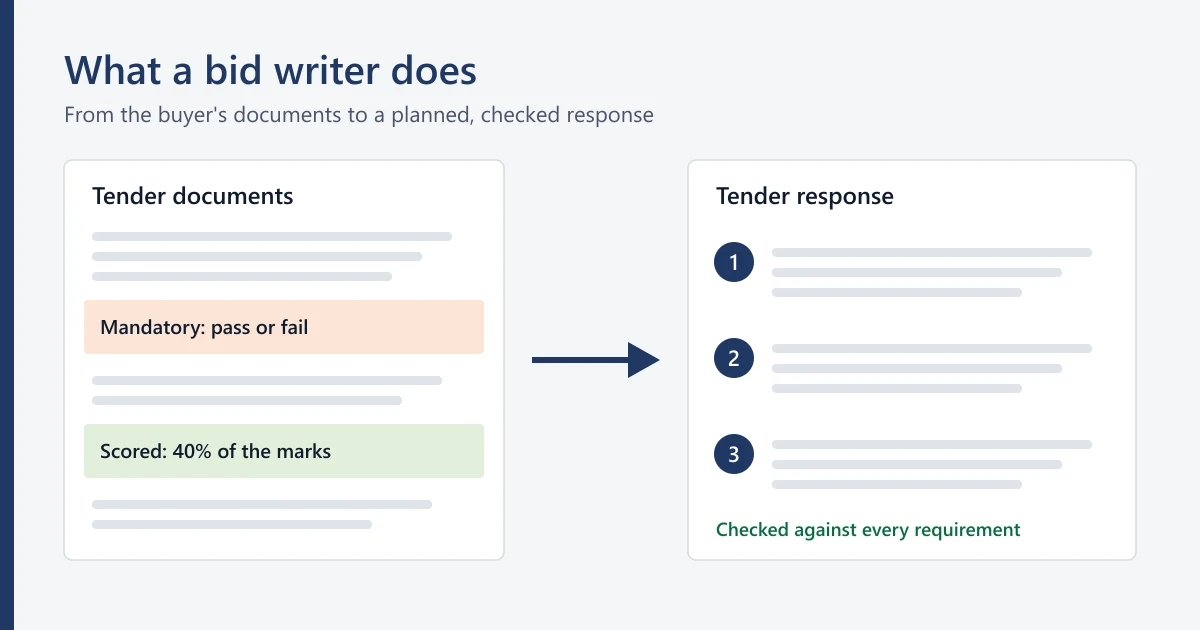
A bid writer turns a buyer's tender documents into a response that can be scored: nothing mandatory missed, every answer written to the marking criteria, sent on time. For a small IT firm, that means a tender stops eating a director's evenings and a bid is not thrown out over a line nobody saw.
What is a bid writer?
A bid writer is the person who gets your tender response over the line. They read every document the buyer published, find what can knock you out and what earns marks, and write the answers to the scoring. Without one, that job lands on whoever in the firm has the least time.
Here is the market you are bidding in:
- £385 billion is spent through UK public procurement every year, on the government's own figure.
- 30 days is the typical time an IT tender gives you from publication to deadline. One in four gives under 25.
- 70% of the score in the typical IT tender is quality, not price. The written answers decide it.
- 17.5% of bids from small firms won, against 27.7% from larger firms, on IT lots that publish bidder size.
Larger firms put a bid team on those 30 days. A small IT firm has a director and the evenings. A bid writer is how a small firm gets the same job done.
Find a Tender figures: our analysis of notices for IT services published 14 November 2025 to 28 February 2026. Typical means the median. Contains public sector information licensed under the Open Government Licence v3.0.
What does a bid writer do, day to day?
A bid writer takes the reading off your desk, tells you early whether the tender is worth your time, and makes sure every mandatory item is covered before a word is written. Then they plan and write the scored answers, so the hours go where the marks are.
The National Careers Service describes the job as preparing "documents that are submitted when organisations bid for contracts". Among the tasks it lists: "write and edit proposal documents and complete forms" and "submit finalised bid documents by agreed deadlines".
On a public sector tender, the work runs in this order:
- Read the tender notice and every attached document. See what an invitation to tender contains.
- Build a compliance matrix, so that no requirement is missed.
- Check the pass or fail conditions, including the Procurement Specific Questionnaire, so that you do not write a bid that cannot win.
- Plan each scored answer against the published criteria and weightings.
- Draft, edit to the word limits and attach the evidence.
- Check the submission against the matrix and send it early.
Steps 1 to 3 are where a tender is won or wasted. They are also the steps a busy director skips.
What is bid writing, and why is it not sales writing?
Bid writing is answering the buyer's questions in the buyer's format so that evaluators can award marks. A brochure persuades. A bid is marked, like an exam. Write to the marking scheme and you collect the marks. Write what you would like to say and you collect none.
The Procurement Act 2023 sets the rules. Under section 23, the buyer must publish how tenders will be assessed and how much each criterion counts. Under section 19, the contract goes to the "most advantageous tender": the one that meets the buyer's requirements and best satisfies those criteria.
Two lines in section 19 are the ones that cost firms contracts:
- A buyer must disregard a tender from a supplier that does not satisfy the conditions of participation.
- A buyer may disregard a tender that breaches a procedural requirement. Cabinet Office guidance gives late submission and exceeding a word count as examples.
Miss one pass or fail line and the rest of your bid may never be scored. Every hour spent on the answers is gone. A bid writer's first job is to make sure that does not happen.
How much does a bid writer cost in the UK?
An employed bid writer costs £26,000 to £55,000 a year in salary, on National Careers Service figures. Freelancers and agencies charge day rates or per-bid fees and rarely publish them. Fixed, published prices do exist: ours are £150 for a bid pack and £750 for a full drafted response.
No official price list exists for freelance or agency work, so compare providers on four questions:
- Is the price fixed, or does it depend on hours?
- What exactly do you get, and in what file format?
- How many rounds of changes are included?
- What happens when the buyer amends the tender after work has started?
Our answers are on the prices section of the homepage. Your first bid pack is free, one per company, so you can judge the work on your own tender before you pay for anything.
When does a small IT firm need a bid writer?
You need one when a tender is worth winning and the people who could write it are booked on client work. The typical IT tender gives you 30 days. If the first ten go on reading, you are writing the answers that carry 70% of the score in a rush.
Signs that help will pay for itself:
- The tender has several documents and you cannot yet say which requirements are scored.
- It is your first public sector bid.
- You have lost bids on points you could have met.
- You are not sure whether to bid, and finding out would take days.
That last one matters most. The cheapest bid is the one you correctly decide not to write. One of our sample tenders came with 68 clarification answers that ruled out a whole route to supply. A firm that missed them would have written a bid that could not win.
Can AI do a bid writer's job?
AI does the heaviest part faster than any person: it reads a whole tender in minutes and pulls out the requirements with their page numbers. Government guidance allows it. PPN 017 says "suppliers' use of AI is not prohibited during the commercial process", and lets buyers ask whether you used it.
The same guidance warns that text from large language models "may include inaccurate or misleading statements". That is the risk to manage, and it is why method matters more than the tool.
Bid Writing Pack is built on that method. Packs are generated by AI, then code checks each quote against the page it cites. That is how a pack arrives within one working day at a fixed price. Because we tell you plainly how your documents were prepared, you can answer a buyer's AI question accurately. See the result on the sample bid pack, built from a live £140,000 IT tender.
What should you check before hiring a bid writer?
Check four things: that they work from the buyer's documents and not a template, that the price and deliverables are fixed in writing, that they use only your real evidence, and that they will tell you when a tender is not worth bidding for. Those four protect your time and your name.
- Method. Do they start with a requirement list you can check against the documents?
- Evidence. Do they ask for your case studies, or write their own? Only the first is safe to submit.
- Speed. When do you see the first output? With 30 days on the clock, a week is a long wait.
- Tools. Do they tell you whether AI is used, so that you can answer the buyer truthfully?
To do it in house, start with our guide on how to write a tender response.
Questions
What does a bid writer do?
A bid writer reads the buyer's tender documents, lists what must be provided and what is scored, plans each answer against the scoring criteria, writes and edits the response, gathers the evidence and makes sure the submission is complete and on time. You get a bid that can be scored, without losing your evenings.
How much does a bid writer cost in the UK?
An employed bid writer earns £26,000 as a starter to £55,000 with experience, on National Careers Service figures. Freelancers and agencies charge a day rate or a fee per bid and rarely publish it. Ask for a fixed price in writing. Ours are published: £150 for a bid pack, £750 for a full drafted response.
Is a bid writer the same as a tender writer?
Yes, in everyday use. Bid writer, tender writer and proposal writer all describe someone who prepares a supplier's response to a buyer's request. The National Careers Service lists bid co-ordinator as another title. In UK public procurement the document you answer is usually called a tender, and the response a bid.
Can a bid writer guarantee that we win?
Nobody can. A public buyer scores every tender against its published award criteria and awards the contract to the most advantageous tender. What a bid writer controls is whether your response is complete, compliant and written to the marks, and whether you spend the hours on a tender you can win.
Can we use AI to write a bid?
Yes. Central government guidance (PPN 017) says suppliers' use of AI is not prohibited during the commercial process, and lets buyers ask whether you used it. Answer that question truthfully, and check every claim in your bid against your own evidence. A service that tells you plainly how it works makes that easy.
Sources
- Bid writer job profile, National Careers Service
- Public Procurement: Growing British industry, jobs and skills. Government response to consultation (CP 1541, March 2026)
- Find a Tender service: notices for IT services, 14 November 2025 to 28 February 2026 (our analysis)
- Procurement Act 2023, section 19: award of public contracts following a competitive tendering procedure
- Procurement Act 2023, section 23: award criteria
- Guidance: Assessing Competitive Tenders, Cabinet Office (updated 17 August 2026)
- PPN 017: Improving transparency of AI use in procurement, Cabinet Office